
Private tour from Amsterdam, windmills, clogs & cheese..
Leaves the cityTastingsPrivate
The countryside at length: windmills, a clog workshop, a cheese farm and the tasting inside the fare.
From $263 per person
Almost every Amsterdam layover comes down to one choice, and it is not which operator. It is whether to spend the hours inside the canal ring or to drive out of it.
Time decides it. Zaanse Schans is twenty-five to forty minutes north of Schiphol by road, and that drive has to fit your margin twice. Under about eight hours on the ticket, the arithmetic does not work and the city wins by default. Over eight, you have a real choice.
| The city | The windmills | |
|---|---|---|
| Time from the terminal | 17 minutes by train, 20–35 by road | 25–40 minutes by road, no direct train |
| Hours it needs on your ticket | 6 or more | 8 or more |
| What you see | Canal ring, Dam Square, the Nine Streets, museums from outside | Working mills, a clog workshop, a cheese farm, green timber houses |
| Cost to walk around | free | free — the village charges nothing |
| Cost to go inside | €16.50 to €25 a museum, timed tickets | €29.50 combined ticket, €15 to park |
| Cheapest departure here | from $218 per person | from $183 per person |
| Works with children | moderately | very well |
| Works in the rain | on a covered boat, yes | less so — it is outdoors |
| Works in December | yes, the city is lit | less so — the light goes at 16:30 |
It is closer, cheaper to reach and impossible to get wrong. The seventeenth-century canal ring was inscribed by UNESCO in 2010, and it is walkable end to end. The Damrak, Dam Square, the Nine Little Streets, the Begijnhof and the flower market all sit inside twenty minutes of one another. Nothing needs a plan more complicated than a direction.
It also flexes. If your inbound slips an hour, a walking route simply starts an hour later. A drive north does not have that give.
And it is the version of the Netherlands almost nobody has seen in person, however many photographs of it they have looked at. Every stop, with the minutes.
It is a different country. Twenty-five minutes north of an international airport there are working mills, grinding pigment and sawing timber on a river. Green timber houses stand along the water beside them, in a shape they have held for three hundred years. It does not feel like a day trip from an airport, which is precisely the point.
The village costs nothing to enter, so the day is cheap once the transport is paid for. The demonstrations — clog-making, cheese — happen in front of you rather than behind glass. And it is much the better choice with children, for reasons covered in the layover-with-kids post.
The catch is the drive, twice, and the fact that it is outdoors. In November it is a long way to go to stand in the rain.
The fares are closer than the difference in character suggests, and the cheapest way to reach the windmills is cheaper than the cheapest way to reach the city.
| From | Basis | Hours | |
|---|---|---|---|
| Windmills, three hours | $183 | per person, from 2 travellers | 3 |
| City loop, three hours | $221 | per person | 3 |
| Windmills and countryside, long | $263 | per person | 4–8 |
| City walk and canal cruise | $330 | per person | 4 |
| Open-route private car | $318 | per group of up to 8 | 3–5 |
Two things fall out of that. The windmills are not the expensive option, which surprises most people. And once there are three or more of you, the per-group fares stop being a premium and start being the sensible choice. That arithmetic is worked through in the costs guide.
Neither figure includes admission to anything, in either direction. The village at the windmills is free to walk into. The canal ring is free to walk through. On a first visit you can spend nothing at all beyond the fare, whichever way you go — which makes this a decision about the day you want rather than about the money.
It is possible on ten hours or more, and only just. The shape that works is windmills first, city second. The drive north is quicker before the morning traffic settles. And the canal ring is a better place to be in the afternoon than a field is, especially once the light starts to go.
That is a nine-hour day with no slack in it. If your connection is shorter than eleven hours, pick one. The arithmetic is here.
The feedback splits along the same line the decision does. Travellers who took a city loop write about the pace and about getting back on time. Travellers who went north write about what they learned — the engineering of a mill, how a clog is cut, why the houses are green.
One review of the countryside day sums the difference up without meaning to: a family travelled from the airport to their hotel by way of the mills and came away, in their words, having learned about the topography, the engineering, the food and the history. Nobody writes that sentence about a drive round a ring road.
The other side of it is honest too. One traveller on a countryside day felt they had been given a taxi rather than a guide. That risk is lower on the shorter, more scripted city products, where the route is fixed and the commentary comes with it. The full set of traveller feedback.
Whichever way it falls, the hours each departure needs are printed on every card at Amsterdam Layover Tours, and the long-layover page sets out what the eighth hour changes.
The countryside at length: windmills, a clog workshop, a cheese farm and the tasting inside the fare.
From $263 per person
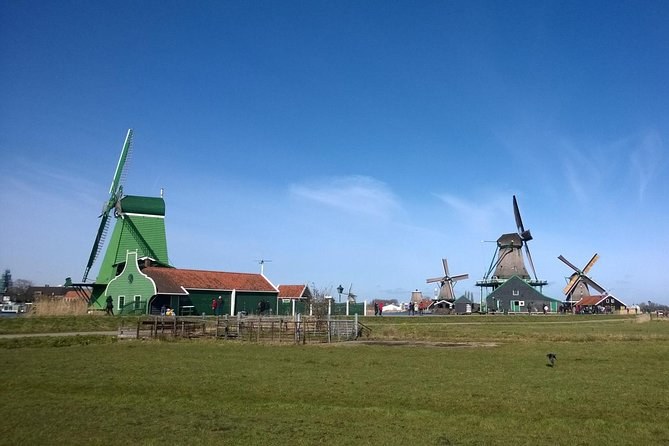
The countryside in three hours flat, which is the shortest way to reach it.
From $183 per person

The city in three hours, with the windmills available as a swap if you change your mind at booking.
From $221 per person
Read next: the windmills tours in full, the canal cruise option, or the same choice with children in the party. To weigh the formats rather than the destinations, see choosing a tour.