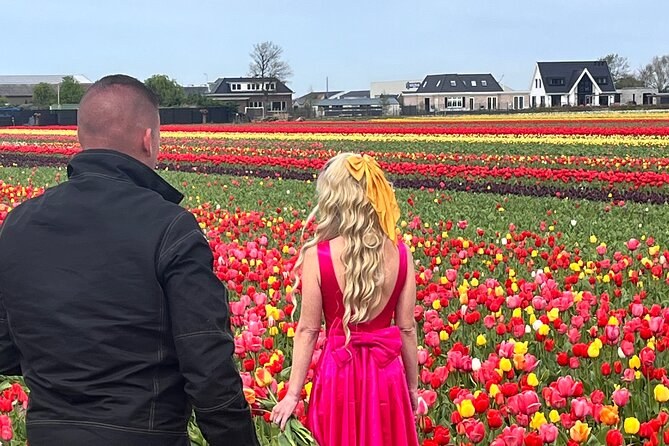
Private tour from Amsterdam, windmills, clogs & cheese..
Leaves the cityTastingsPrivate
Best from March to May, when the tulip fields north of the airport come into range.
From $263 per person
Amsterdam gets between seven and three quarter hours of daylight in December and sixteen and three quarter in June. On a layover, that nine-hour swing decides more than the weather does.
Three things, in order of importance. How much light you have when you land at Schiphol. Whether the outdoor half of the day is pleasant. And whether the tulip fields north of the airport are in flower.
What it does not change: the hours the museums keep, the price of the train, or how long passport control takes. Those are constant, which is why the seasonal question is really a daylight question.
| Month | Sunrise | Sunset | Daylight | Rain days |
|---|---|---|---|---|
| January | 08:43 | 16:56 | 8h 12m | 12.2 |
| February | 07:57 | 17:52 | 9h 55m | 10.8 |
| March | 06:55 | 18:43 | 11h 48m | 9.7 |
| April | 06:44 | 20:37 | 13h 54m | 8.6 |
| May | 05:45 | 21:28 | 15h 43m | 8.9 |
| June | 05:18 | 22:04 | 16h 46m | 9.7 |
| July | 05:36 | 21:56 | 16h 20m | 10.9 |
| August | 06:23 | 21:07 | 14h 44m | 11.6 |
| September | 07:14 | 19:57 | 12h 43m | 10.9 |
| October | 08:05 | 18:47 | 10h 42m | 12.4 |
| November | 08:01 | 16:49 | 8h 48m | 13.4 |
| December | 08:44 | 16:27 | 7h 43m | 14.1 |
Sunrise and sunset are for the fifteenth of each month. Rain days are the Royal Netherlands Meteorological Institute's 1991–2020 normals. The full weather page.
Yes, with one adjustment: land before about one in the afternoon, or accept that you are visiting in the dark.
A December connection landing at 14:00 has roughly two and a half hours of light. That is enough for one neighbourhood and no more. What it is emphatically not enough for is the countryside, where the point is the view.
The compensation is real. Zaanse Schans is a poor bet in the dark, but the canal ring is lit from mid afternoon, the water carries the light, and the city is at its least crowded. A glass-topped boat is a warm place to spend an hour, and the museums keep the same hours in January as in June.
March turns it around. Daylight passes eleven hours, rainfall drops to its lowest of the year, and the tulip fields begin.
April is the best month for a layover here, and the numbers are not close: 39.6 mm of rain across 8.6 days, nearly fourteen hours of light, and comfortable afternoons at fourteen degrees. It is also peak tulip season, which puts Keukenhof and the bulb fields inside reach of a long connection.
The caution is that spring is when the countryside departures fill. Book earlier than you would in November.
Long and wetter than people expect. June gives sixteen and three quarter hours of daylight and sunset a few minutes past ten, which means an evening arrival still has a usable afternoon in it.
July is the warmest month at 22.5 degrees. August is the wettest month of the year, at 98.6 mm across 11.6 days — a fact that surprises almost everyone. Dutch summer rain arrives as short heavy showers rather than settled fronts, so it usually costs an hour rather than the day.
September is the quiet recommendation. Warm afternoons, the best light on the water, twelve and three quarter hours of daylight and noticeably fewer people than August.
October and November are where it turns. Sunset falls back below seven, then below five, and the rain days climb to the highest of the year. By November a midday arrival has about four hours of usable light and an afternoon one has almost none.
| Best months | Why | |
|---|---|---|
| Overall | April, May | Most light for the least rain, and the tulips. |
| For the windmills | April to September | The point is the view, and it needs daylight. |
| For the canal ring on foot | April to October | Comfortable walking, long evenings. |
| For a canal cruise | any month | The boat is glass-topped; only the reflections change. |
| For museums | November to February | Same hours, fewer people, and the weather is irrelevant indoors. |
| To avoid | November | Least sunshine, most rain days, and dark by five. |
Central European Summer Time starts on the last Sunday in March and ends on the last Sunday in October. Both shifts move sunset by an hour overnight, and both fall exactly where the daylight curve is steepest.
The October change is the one that catches people. An afternoon connection that had comfortable light one weekend has an hour less the next, and by the middle of November it is dark before five.
Less than you would think, because two of the three things you might book are indoors by design. A private car is a car. The canal cruise runs on a covered boat, so an hour on the water in November reads much like an hour in June.
Only a walking tour is genuinely affected, and the answer there is a coat rather than a cancellation. One operator states plainly that it runs in all weather and asks you to dress for it.
Almost everything, almost always. The Rijksmuseum and the Van Gogh Museum open daily year round, and the Anne Frank House runs 09:00 to 22:00 every day.
The exception is seasonal rather than daily: Keukenhof opens for about eight weeks in spring and is shut the rest of the year. If the tulip gardens are the reason you are leaving the terminal, check the dates before you book anything.
More than people expect, and it is worth planning around if a picture of the canals is part of why you are leaving the terminal.
The canal ring runs on a roughly north-west axis, so the light falls along the water rather than across it early and late in the day. In June that useful hour arrives at about nine in the evening, which a long connection can easily reach. In December the equivalent hour is at half past three, which most afternoon arrivals will miss.
Winter has one compensation nothing else matches: the bridges and the canal houses are lit from mid afternoon, and the water doubles all of it. A dark layover produces different photographs, not worse ones.
August is the busiest month in the centre and September is noticeably calmer for very little loss in weather — nineteen degrees by afternoon and the best light of the year on the water. If your dates are flexible, that trade is the easiest win available.
Spring is busy in a different way. Tulip season concentrates a great deal of demand into about eight weeks, and it lands on the countryside departures rather than on the city ones. If you are travelling in April and the windmills or the gardens are the point, book earlier than you would in any other month.
The quietest stretch is January and February. Fewest visitors, same museum hours, and the lowest fares of the year on almost everything — against eight to ten hours of daylight and rain on eleven or twelve days.
Two dates are worth knowing about before you plan a connection around them.
King's Day, 27 April. The whole city turns orange and takes to the canals, and the centre becomes close to impassable by car. It is a remarkable thing to walk into by accident and a poor day to have a schedule.
Christmas and New Year. Shops close, museums mostly do not, and the canal ring is at its best under lights against seven and three quarter hours of daylight. Traffic is light, which makes it one of the easier weeks of the year for a driven route.
In the long half of the year, take the countryside — the mills, the cheese farm and the harbour are all outdoor propositions and they need the light. In the dark half, take the city, and lean towards anything with a roof on it.
In April and May, if your connection can carry it, take the countryside and ask about the tulip fields. It is a genuinely different day from the one available in October, and the departures at Amsterdam Layover Tours that go north say which grades run when.
Best from March to May, when the tulip fields north of the airport come into range.
From $263 per person
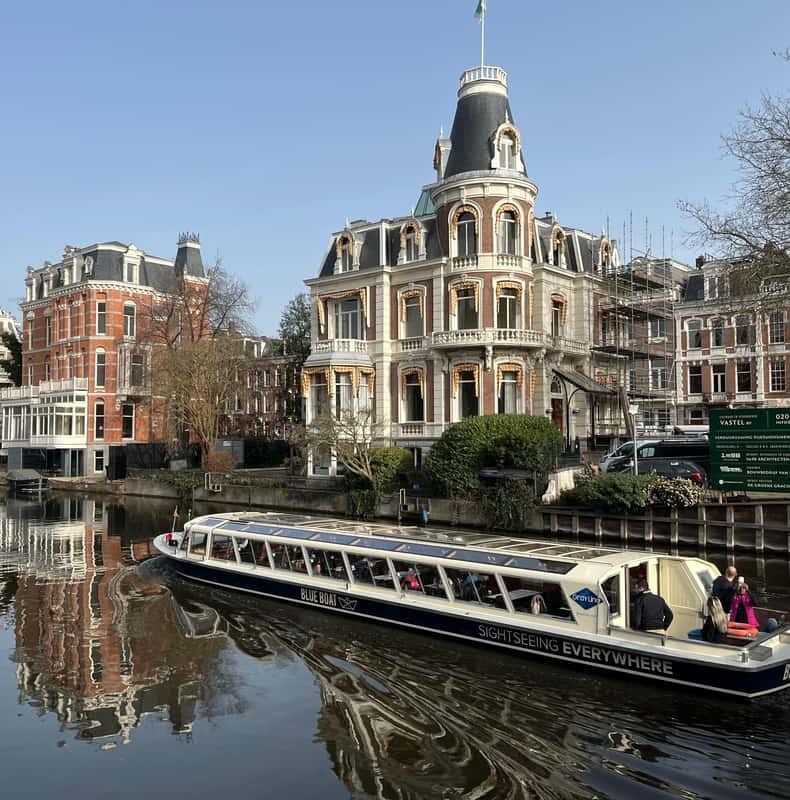
Year-round: the boat is glass-topped, so November reads much like June from inside it.
From $330 per person
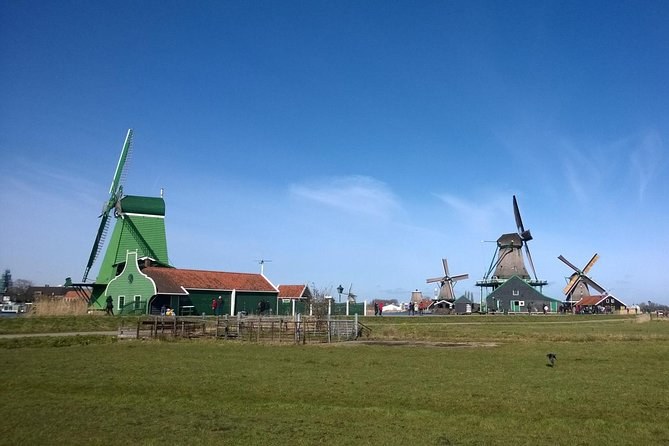
Best in the long half of the year, when there is light left after the drive north.
From $183 per person
Next: the month-by-month weather page, or what fits in the hours you have. For the countryside in spring, see the windmills tours.